The Financial District has spent the last two decades converting office towers into residential buildings, which makes it one of the more unusual New York City submarkets for a 1031 exchange: a seller might be exiting a stabilized office floor, a residential conversion unit, or a hotel that itself began as an office building.
Office-to-Residential Conversion History
Buildings along Broadway, Water Street, and John Street have converted from commercial office to rental and condominium residential use going back to the years following September 11, and that conversion wave has continued as office demand shifted post-pandemic. A seller exiting a converted residential building here is really selling a former office asset with a new use, and basis calculations often trace back through the conversion date.
Owners still holding pure office space in the district face a different set of buyers than those holding converted residential, since conversion candidates trade on repositioning potential rather than current office rent roll.
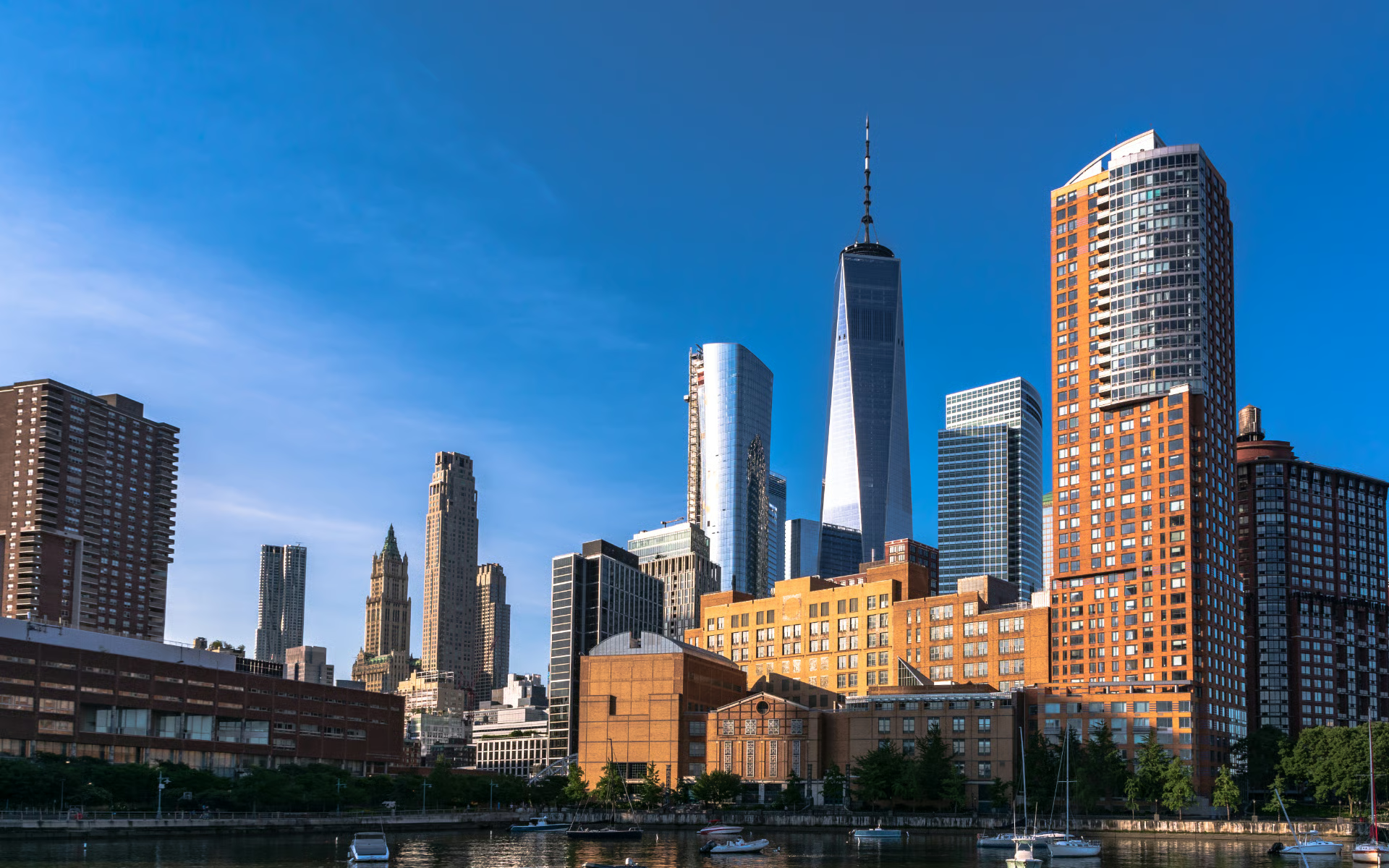
Battery Park City, built largely on landfill along the Hudson River, sits just west of the historic core and functions as its own submarket within the broader district, with residential towers, a mix of ground-floor retail, and Brookfield Place's office and retail complex all financed on more standardized institutional terms than the older conversion-candidate buildings closer to Broadway.
Historic Towers and Modern Repositioning
The district's historic prewar towers sit alongside newer construction near Battery Park City and the World Trade Center campus, and each vintage attracts a different buyer pool. Older buildings often draw conversion-focused buyers, while newer towers trade closer to stabilized office or residential comps.
A seller comparing replacement candidates across this range needs to know whether a given building is being bought for its current income or for its conversion upside, since those two scenarios finance very differently.
The Seaport district, at the district's eastern edge, holds a smaller concentration of low-rise buildings, many within the South Street Seaport Historic District, which carries its own Landmarks Preservation Commission review requirements distinct from the taller towers further inland. Retail and restaurant space here leans on tourism and the redeveloped pier complex rather than office worker foot traffic, which makes it a different underwriting exercise than a Broadway-facing office conversion. A buyer evaluating a Seaport-area building should also confirm its landmark status separately from a Broadway or Water Street property, since the district's designation boundaries do not track the broader Financial District's zoning lines exactly.
Replacement Property Paths for FiDi Sellers
Financial District sellers typically weigh a few distinct replacement paths:
- Another conversion or repositioning candidate in Lower Manhattan
- Stabilized office space in a different New York City submarket
- Residential rental property, direct-owned or through a Delaware Statutory Trust
- Single-tenant net-lease retail as a lower-management alternative
Working the 200% and 95% Tests
Because Financial District properties can carry high individual values, sellers who want to keep several candidates open often rely on the 200% rule rather than the three-property rule, since a short list of expensive office or residential towers can quickly exceed the value cap under a straightforward count-based approach.
The 95% rule, requiring the taxpayer to acquire 95% of everything identified, comes up more often here than in smaller submarkets, typically when a seller has identified more candidates than the 200% cap allows and needs an alternative path to stay compliant.
What Changes When the Relinquished Asset Is a Conversion
Selling a converted residential unit or building adds a documentation step: the file needs a clear record of when the conversion occurred and how the building's basis was allocated at that point, since that history carries forward into the replacement property's depreciation schedule.
A CPA should review that history early in the process, ideally before the 45-day identification deadline, so any basis questions don't surface for the first time when Form 8824 is being prepared the following year.
Common 1031 Exchange Questions
Does a residential condo converted from office space qualify as like-kind to raw office space?
Yes, provided both are held for investment or business use. The prior office designation does not affect the property's eligibility once it has been converted and is being sold as residential real estate.
Why do Financial District sellers use the 200% rule more often than the three-property rule?
Financial District properties often carry high individual values, so a short list of just three candidates can be harder to assemble at a workable price point. The 200% rule allows more candidates as long as their combined value stays within twice the sale price.
Can a seller exchange office space for a hotel that used to be an office building?
Generally yes, since both remain real property held for investment or business use, though a hotel's operating income structure typically requires different underwriting than a straight office or residential lease.
What documentation does a conversion property need beyond a standard closing statement?
A record of the conversion date and how basis was allocated at that time, since that history affects depreciation calculations carried into the replacement property.
How does the 95% rule apply if a Financial District seller identifies more candidates than the 200% cap allows?
Under the 95% rule, the taxpayer can identify any number of candidates regardless of combined value, but must actually acquire 95% of that identified value by the end of the exchange period, which is a stricter standard than the other two rules.